
Siak Regency Government Partners with ICEL and NGOs to Conduct Permit Review
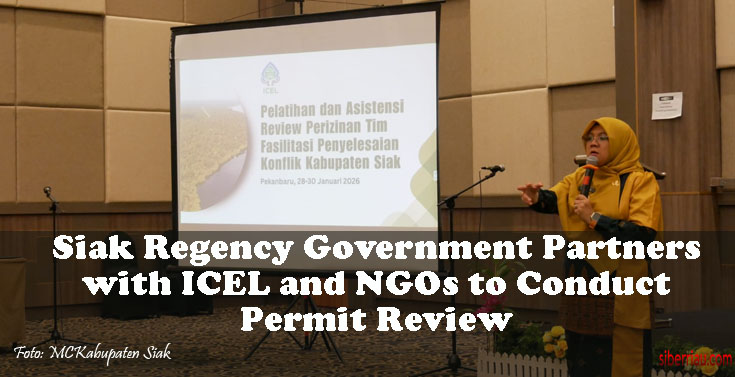
Siak, Siberriau – The Siak Regency Government partnered with the Indonesian Center for Environmental Law (ICEL) and civil society organizations (NGOs) to provide assistance and mentoring for a permit review in Siak Regency. The activity lasted three days, from January 27 to 29, 2026.
This activity was part of a pentahelix collaboration to resolve forest and land conflicts in Siak Regency.
This collaboration was strengthened by Siak Regent Decree No. 100.3.3.2/713/HK/KPTS/2025 concerning the Establishment of the Forest and Land Conflict Resolution Facilitation Team (TFPK).
In this activity, ICEL, supported by The Asia Foundation, provided capacity building to the TFPK Team, particularly regarding the methodology and approach to permit review.
The two companies targeted for the initial permit review were PT Duta Swakarya Indah (DSI) and PT Seraya Sumber Lestari (SSL). PT SSL holds an Industrial Plantation Forest (HTI) permit, while PT DSI operates in the plantation sector.
The Head of the TFPK Team, Anton, stated that this activity is part of the team's collective work in response to the high level of agrarian conflict in Siak Regency.
Based on collected data, Siak Regency is listed as one of the areas with the most extensive agrarian conflict in Riau Province.
"The area of ??agrarian conflict in Siak covers approximately 60,955 hectares, with 6,992 families affected. The largest conflict originates from the forestry sector, covering 53,112.7 hectares and impacting 4,197 families, while the plantation sector covers approximately 7,598 hectares, with 2,795 families affected," Anton said.
He added that currently, approximately 90 villages in Siak Regency are involved in agrarian conflict. Several conflicts of particular concern to the team are those involving PT DSI and PT SSL, which have recently resurfaced within the community.
Meanwhile, ICEL Director Lasma emphasized that the permit review is a crucial step in law enforcement and improving forest and land governance. According to her, strengthening the capacity of the TFPK Team is the initial foundation for systematic and equitable conflict resolution.
"We appreciate the Siak Regent's commitment to establishing the TFPK Team. The team's composition, which involves various stakeholders, reflects openness and a spirit of collaboration. For ICEL, this is not the final goal, but rather the beginning of a long process of resolving forest and land conflicts through a law enforcement approach," Lasma said.
On the second day of the event, the Siak Regent also attended and emphasized that the permit review is a very urgent agenda that requires serious pentahelix support. He highlighted the disparity between land control by the forestry industry and the fiscal benefits received by the region.
"In Siak Regency, industrial timber plantations (HTI) control approximately 300,000 hectares of land. However, the forestry sector revenue sharing fund received by the region is only around 13 billion rupiah. Meanwhile, the HGU (Harvest Permit) covers over 250,000 hectares, yet Siak only receives around 7 billion rupiah in revenue sharing. This is clearly disproportionate to the social, environmental, and conflict burdens we must bear," said the Regent.
According to the Regent, the obligation to rehabilitate forests continues to be placed on the region, while authority and fiscal support are very limited. This situation makes resolving forestry and agrarian conflicts an urgent need in Siak Regency.
"This is the main reason I wanted to become Regent of Siak," he said.
The Regent also highlighted the complexity of conflicts in his region, including the approximately 41,000 hectares of forest area that serves as Sumatran tiger habitat, as well as various unresolved tenurial conflicts.
He stated that the Siak Regency Government continues to strive for breakthroughs, including opening opportunities for carbon trading schemes, even though the region's voice is often not heard at the national level.
"If the authority were vested in the Regent, if the recommendations were clear and strong, I would guarantee that the permits would be revoked. Because the existing permits do not provide real benefits to the region and the community," he asserted.
He also emphasized the importance of political courage in addressing the gray areas in forest and land governance. According to him, the struggle to defend community rights to forests and land must be accompanied by regulatory reforms that are fairer for producing regions.
"It is time for a constitutional review of the Forestry Law because its practices have not provided justice for regions and communities at the grassroots level," he said.
The Regent requested that every recommendation produced by the TFPK Team be submitted to relevant ministries and institutions, including the Coordinating Ministry for Political, Legal, and Security Affairs, the Coordinating Ministry for Economic Affairs, the Indonesian National Police, and the Attorney General's Office as part of efforts to encourage comprehensive conflict resolution. (MC Siak Regency).
- Pemkab Rokan Hulu Mantapkan Persiapan Penilaian Indeks Kualitas Kebijakan (IKK) Tahun 2026
- Perkuat Komitmen Cetak Atlet Disabilitas Intelektual Berprestasi
- Komisi III DPRD Dampingi Pemkab Kuansing Jemput Dukungan Infrastruktur Digital di Kementerian Komdigi
- Kepala Puskesmas Tanah Putih Yusriani, SKM Gerakkan Kampanye Hidup Sehat dan Sukseskan GERMAS
- Aisya Fhatih Az-Zahra Kunjungi STAI Ar-Ridho Bagansiapiapi
- STAI Ar-Ridho Bagansiapiapi Gelar Pembekalan Dosen dan Mahasiswa KKN-PPL Angkatan XIV
- 18 Gasing dan 54 Layang Ikuti Lomba Permainan Anak Negeri Sempena Hari Jadi ke-514 Bengkalis

siberriau.com adalah Situs berita riau terkini, media online yang melayani informasi dan berita dengan mengutamakan kecepatan serta kedalaman informasi. Portal berita ini selama 24 jam dalam sepekan selalu update, dan secara kreatif mengawinkan teks, foto, video dan suara dan kami fokus pada pembaca di Indonesia dan Riau khususnya, baik yang berada di tanah air maupun yang tinggal di luar negeri. Selengkapnya

Quick Links
Kanal
Alamat Perusahaan
Perumahan Pesona Alam Pandau Blok Sakura 1 Nomor 7 RT 02 RW 04
Dusun V Sei Tangon Permai Desa Pandau Jaya Kecamatan Siak Hulu Kabupaten Kampar Provinsi Riau
Alamat Redaksi
Perumahan Pesona Alam Pandau Blok Sakura 1 Nomor 7 RT 02 RW 04
Dusun V Sei Tangon Permai Desa Pandau Jaya Kecamatan Siak Hulu Kabupaten Kampar Provinsi Riau